What is the luminosity of the observable universe (excluding the blackholes)?
This is Fermi estimation problem: Find the mass of the sum, calculate the mass to energy conversion, and calculate the time needed for a photon to escape the center
The escape time is roughly a billion years, which gives a luminosity of around $10^{37}$
There are roughly $10^{10}$ stars in the universe. Assume all stars are like the sun
There are also roughly $10^{10}$ galaxies in the universe
Combining these gives that the luminosity of the universe is $10^{53}$
The point of this is that gravity is very efficient at converting mass to energy
If the black hole is moving close to the speed of light towards you (pileup of photons), then the observed luminosity can exceed this threshold
Gamma ray bursts (GRBs) are the prime example of this boosted luminosity
Imagine a EM wave propagating along the $\hat{z}$ direction. This will oscillate an electron in a direction transverse to z (fix this direction to be x)
This oscillating generates the radiation
Newton’s 2nd Law, and letting $E(z,t) = exp(i\omega t) \hat{x}$, the resulting motion is $x(t) = A exp(i\omega t)$ where $A = \frac{qE(z)}{m\omega^{2}}$
The cross section scales like $A^{2}$, which means that the cross section of the proton is roughly 1 million times smaller than the electron
Setting the gravitational force (ignoring the electron mass) equal to the radiative force (ignoring the proton cross section) gives the target luminosity (re: Eddington Luminoosity) as $L_{edd} = \frac{4\pi c G M m_{p}}{\sigma_{T}}$
Setting the mass scale to that of the sun, we get that $L_{Edd} = 1.3E38 (\frac{M}{M_{*}}) \frac{ergs}{s}$
For a black hole, $L_{edd} = 1.5E45 M_{7} \frac{erg}{s}$ where $M_{7} = \frac{M}{1E7 M_{*}}$
If we assume that the object is a perfect blackbody, we can define an effective temperature $L = 4\pi R^{2} \sigma_{B} T_{eff}^{4}$
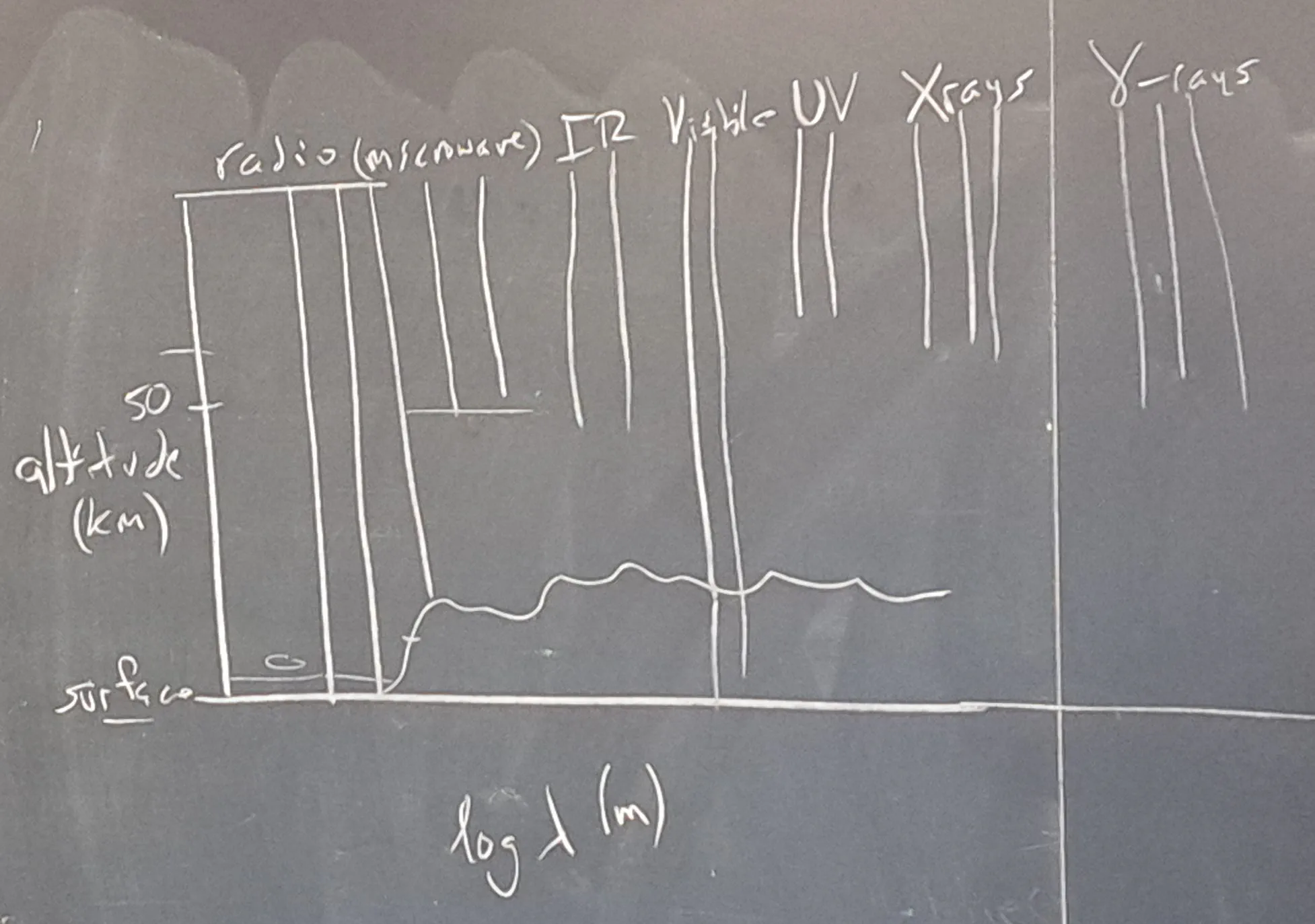
Our atomsphere absorbs different amounts of radiation depending on the frequency
This change is absorption is described by the opacity of the sky
The above sets constraints on where expeiments/telescopes can be (radio and visible can be ground based, but other bands might demand high altitudes or be in space)
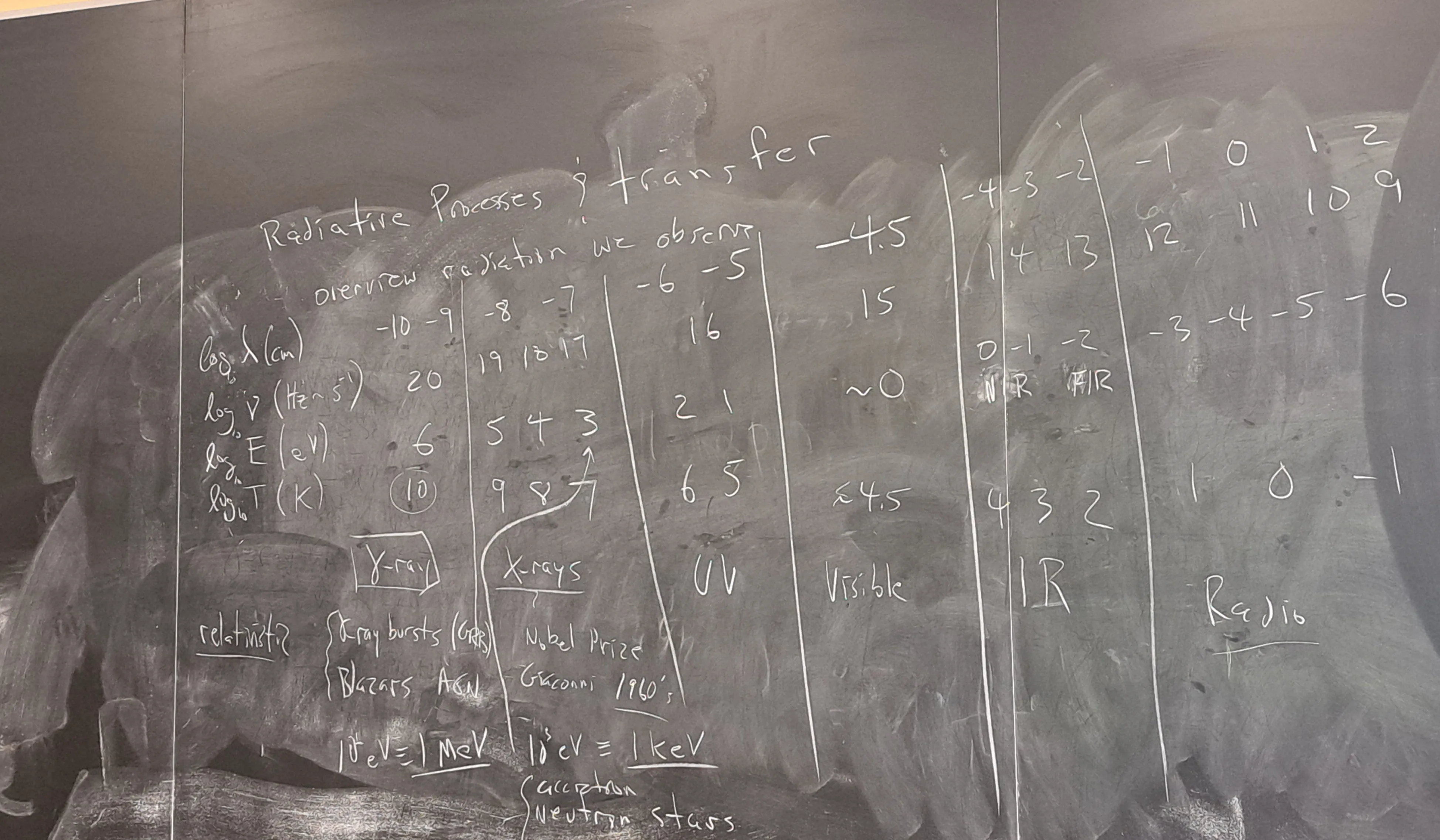
There exists cosmic rays which are protons of energies 1E21 eV
The LHC boosts protons to 1E13 eV
When they hit the atmosphere, they create showers of high energy particles, which produce Cherenkov radiation cones in the air
There is a hierachy of densities in our Universe:
On earth, the density of air is roughly 1E20 per cc
In the ISM, there is a density of 1E0 particles per cc
In the IGM, there is a density of 1E-6 per cc
In the ISM and IGM, the mean free path $\lambda = \frac{1}{n \sigma}$ is very long, which lets particles get accelerated for a long time before getting scattered
These are objects in the ISM which form in slightly over-dense regions
They are called “star nurseries”
Point being, despite being made up of a bunch of particles, collectively the clouds have some average velocity in some direction
There are a lot of these molecular clouds scattered around. Fermi realized that a particle could bounce off of these clouds and potentially gain these massive energies
This hinges on the fact that the velocity distribution of the clouds is assymetric
A non-relativistic calculation of this phenomena:
Let $\Delta$ be the distance from the particle to the nearest cloud
Let $v$ and $V$ be the velocities of the particle and the cloud respectively
Let’s calculate the probability of a collision
The time until a head-on collision is $\tau_{u} = \frac{\Delta}{v+V}$
The velocities point in opposite directions
The time until a catch-up collision is $\tau_{c} = \frac{\Delta}{v-V}$
The velocities point in same direction
The probability of a head-on collision is $\frac{\frac{1}{\tau_{u}}}{\frac{1}{\tau_{u}}+\frac{1}{\tau_{c}}} = \frac{v+V}{2v}$
The probability of a catch-up collision is $P_{c} = \frac{v-V}{2v}$
What is the change in energy for each case?
Assume that the mass of the cloud is much larger than the particle. This is just an elastic collision
For a head-on collision: velocity after the collision is $v+2V$, hence $\Delta E_{h} = \frac{m}{2} (v+2V)^{2} -\frac{m}{2} v^{2}$
For a catch-up collision: velocity after the collision is $-v+2V$
What is the expected change is energy? Its $<\Delta E > = \Sigma_{i} P_{i} E_{i}$
Doing that calculation out gives $\frac{<\Delta E >}{E} = 4 (\frac{V}{v})^{2}$
This is a 2nd order process (b/c of the -2), which means it’s pretty inefficient
This Fermi acceleration is a general concept. There are “converging magnetic flows” where the “clouds” are always moving towards you. Hence you get a more efficient energy gain
Let $\frac{dE}{dt} \propto \nu < \Delta E>$, where $\nu$ is the frequency of collisions
For the molecular clouds, we see that $\frac{dE}{dt} = \alpha E$ for some characteristic $\alpha$ of the ISM
Let’s think of this problem in phase space, where our axes are E and x
Think Stokes Theorem, where the flow on the boundary and the production of particles determines the change in the number of particles in some volume
The spatial flux is defined by $\phi_{s} = -D \frac{\partial N}{\partial x}$, where D is some diffusion constant
The energy flux is $\phi_{e} = \frac{N \Delta E}{\Delta t}$
We define some timescale $\tau$, which dictates how quickly particles leave the system (for instance, the Larmor radius grows so large so as to leave the system). This then gives that $\frac{\partial N}{\partial t} \approx -\frac{N}{\tau}$
For molecular clouds, D=0, and the system is in equillibrium, so $\frac{dN}{dt} = 0$
Solving for N yields $N(E) \approx N_{0} exp(-(1+\frac{1}{\alpha}{\tau}))$ where $\alpha = 4 \nu (\frac{V}{v})^{2}$
In log-log space, this is a straight line (re: a power law)
We also make the ideal assumption (re: no resistivity)
This gives that there is no Lorentz force in the plasma (re: if there was a force, then due to no resistivity, the charges would rearrange themselves and short out the force)
Hence we have $\vec{E} \approx - \frac{\vec{v}}{c} \times \vec{B}$
We add on the additional constraint of conservation of mass:
A thin disk is defined as being thin in the z-axis (due to being cold and having low pressure)
The radial pressure gradient is negligible
A thicker disk is hotter (hence larger pressure gradients)
How does all the gas fall into the black hole when the portions of the disk have angular momentum?
There is a net flux of angular momentum out of the disk
Imagine a ring of gas of radial thickness dR at radius R. The angular momentum on the inside is $R\Omega(R)$, where $\Omega(R) = \frac{v_{\phi}}{r}$, and on the outside is $(R+dR)\Omega(R+dR)$
We imagine that there is some particle exchange from inside the disk to the outside, and vice versa
The torque due to the outflow is $\tau = \dot{M_{1}} (R+dR) R \Omega(R)$
The torque due to the inflow is $\tau = \dot{M_{2}} R(R+dR) R \Omega(R+dR)$
In short, the particles keep their old angular momentum as they cross the boundary
The inflow and outflow mass rate are the same ($\dot{M_{1}} = 2\pi R \rho(R) H \tilde{v}$).
H is the height of the disk. $\rho(z)$ is the density. $\tilde{v}$ is the average radial velocity of the disk
Hence, the net torque is $\tau = \dot{M_{1}} R(R+dR)(\Omega(R)-\Omega(R+dR)) = 2\pi R H \tilde{v} \rho(z) R(R+dR)(dR \Omega’(R))$
The kinematic viscosity is defined as $\nu = dR \tilde{v}$ (units of length squared over time)
Hence: $\tau = -2\pi \nu \epsilon R^{3} \Omega'$
There is a characteristic length and velocity scales in the problem (height of disk and speed of sound). You can encode this in the kinematic viscosity via $\nu = \alpha c_{s} H$, where $0 \leq \alpha \leq 1$
Due to the viscosity of the gas, the friction generated causes the gas to radiate like a blackbody
The mass flow of a ring is given by $R\frac{\partial \Epsilon}{\partial t} + \frac{\partial}{\partial R}(R\Epsilon v_{R}) = 0$
Imagine the mass flow at the inner and outer radii, then take the limit as dR goes to 0
$\Epsilon$ is the mass density of the ring, $v_{r}$ is the radial velocity
Similarly, there is a flow of angular momentum: $R \frac{\partial}{\partial t}(\Epsilon R^{2} \Omega) + \frac{\partial}{\partial R}(R\Epsilon v_{r} R^{2}\Omega) = -\frac{1}{2\pi} \frac{\partial \tau_{out}}{\partial R}$
Same story: Take the difference between the inner and outer disks, and also add on the torques at the inner and outer rings
Since the rings are Keplerian, we know that $\Omega = \frac{v}{R} \propto R^{-\frac{3}{2}}$
We can combine mass and angular momentum conservation, along with the Keplerian ring assumption to calculate the radial velocity: $v_{r} = -\frac{3}{\Epsilon R^{\frac{1}{2}}} \frac{\partial}{\partial R}(v \Epsilon R^{\frac{1}{2}})$
We can define $\dot{m} = 2\pi R \Epsilon (-v_{R})$
We can describe our system as a function of pressure, velocity, and density at all x,y,z,t. These are not all conserved.
We can construct a set of conserved variables from these: the total energy density (kinetic plus thermal), the momentum density and the density itself
There are two pictures of flows that are useful
The Eulerian description imagines that you fix a box in space. You then look at the flow of stuff through the faces of the box and any stuff which gets generated in the box
The Lagrangian description follows a particular section of stuff around as a function of time and space
With conservation of mass, we see that $\frac{\partial \rho}{\partial t} + \nabla \cdot (\rho \vec{v}) = 0$
Can derive by looking at the mass flow in a little box is size $\delta V = \delta x \delta y \delta z$
With momentum conservation, we find that: $\frac{\partial}{\partial t}(\rho \vec{v}) + \nabla \cdot (\rho \vec{v}\vec{v}) = -\nabla \cdot \sigma + \vec{F_{b}}$
$\vec{v}\vec{v}$ and $\sigma$ are 3x3 matrices (re:tensors)
You can split the stress tensor into diagonal pressure components and off-diagonal shear components
You can dot the above with $\vec{v}$ to get an power conservation law
This describes the accretion of cold gas onto a central mass where the flow is primary in the radial direction
The interstellar medium (ISM) is such a cold gas
Far away from the center accretor, the thermal energy density is given by $\rho c_{s}^{2}$. Define some radius $R_{a}$ where the thermal energy density equals the gravitational energy density
Another relavent radii is $r_{s}$ (the sonic radius), where in infalling gas speed equals the sound speed
Imagine that you have some steady radial flow:
From mass conservation, we know that $\frac{1}{r^{2}} \frac{d}{dr}(r^{2}\rho v) = 0$
The mass accretion rate is then defined as $\dot{M} = 4\pi r^{2} \rho (-v)$ (minus sign since the gas is always moving inwards)
From the momentum conservation, we have that $+\frac{\nabla P}{\rho}+ \frac{GM}{r^{3}} + v \frac{dv}{dr} = 0$
We assume an equation of state $P = D \rho^{\Gamma}$, which is representative of some ideal gas equation of state (or if $\Gamma=1$, it’s an isotherm)
If we define $c_{s}^{2} = \frac{dP}{d\rho}$, do some chain rule to change $\frac{dP}{d r} = \frac{\partial P}{\partial \rho}\frac{d \rho}{dr}$, and incorporate the mass continuity equation, we see that:
This describes a transition from subsonic to supersonic speed
Radii which this occurs at is when $v(r_{s}) = c_{s}(r_{s})$, which translates to $r_{s} =frac{GM}{2c_{s}^{2}(r_{s})$
We know the sound speed and the density at infinity. We need to relate these parameters to the values at $r_{s}$
Look at energy conservation: $\frac{1}{2}v^{2} + \int \frac{dP}{\rho} - \frac{GM}{r} = constant$
Assuming that $\Gamma \neq 1$, we know that v=0 at $r=\infty$. This let’s you write the sound speed as a function of the boundary conditions. Remembering that $v = c_{s}$ at $r_{s}$, we see that:
We define the ratio between the two masses as $q = \frac{M_{2}}{M_{1}}$, where $M_{2} \leq M_{1}$
In an inertial frame, the potential is just the sum due to each mass
In a co-rotating frame, you can peg the masses in place, and add in some additional potential to model this rotation
For simplicity, we will only assume that the centrifugal force is relavent. Euler and Coreolis forces are small
The centrifugal acceleration is $-\omega\ \times \omega \times r$, which means the potential is $\Phi(r) = -\frac{1}{2}(\vec{\omega}\times \vec{r})^{2}$ (just take the derivative w.r.t. r! to get back the force!)
The relavent lengths of the system are:
The binary separation a: related to the period via Kepler’s Law: $4\pi^{2}a^{3} = G(M_{1}+M_{2})P_{orb}^{2}$
$R_{i}$ the average radii of each mass
$b_{i}$ the distance from the mass to the L1 Lagrange point
The equipotentials of this system in the co-rotating frame looks like two lobes which meet at the Lagrange point L1
Some heutristics for how these parameters evolve are:
Imagine you have an electron moving through a constant magnetic field. Align your coordinate system along the electrons velocity, with the z axis orthogonal in the direction of the B field
There is some pitch angle $\alpha$ which the electron makes with the B field
the gyration radius is given by $r_{g} = \frac{v\sin\alpha}{\omega_{g}}$ where $\omega_{g} = \frac{eB}{m_{e}c}$ ( follows from Lorentz force law)
The radiated power in the electron’s rest frame is then $P = \frac{2e^{2}}{3c^{3}}\omega_{g}^{2} v \sin^{2} \alpha$ (Larmor formula)
The power emitted by the electron in some other frame is $P’ = \frac{4}{3} \sigma_{T} c \beta^{2} \gamma^{2} u_{B}$
$\sigma_{T}$ is the Thompson cross section (need Klein-Nishina if quantum is important)
$U_{B} = \frac{B^{2}}{8\pi}$
You also need to average over the pitch angle: $\int 2\pi \sin^{3} \alpha d\alpha = \frac{8\pi}{3}$
Since energy and time both have the same transformation, then the above powers are the same
This means that the energy gets relativistically beamed forwards
As the electron whips around, the beam very quickly enters and leaves the line of sight of an observer
Hence, the time we observe the beam is short, which means the frequency content is very large (hence why radio pulsars are a thing…)
The width of the cone is roughly $\frac{1}{\gamma}$
The actual measured power depends on the velocity distribution of electrons